Working principle of Four-Pillar Hydraulic Press Machine
Hydraulic oil is transported to the integrated cartridge valve block by the four pillar hydraulic press machine, which functions as an oil pump. The hydraulic oil is supplied to the cylinder’s upper or lower chamber via each check valve and relief valve, and the high-pressure oil moves the cylinder. A hydraulic press is a machine that transfers pressure through liquid. Pascal’s law explains how a liquid distributes pressure in a restricted container.
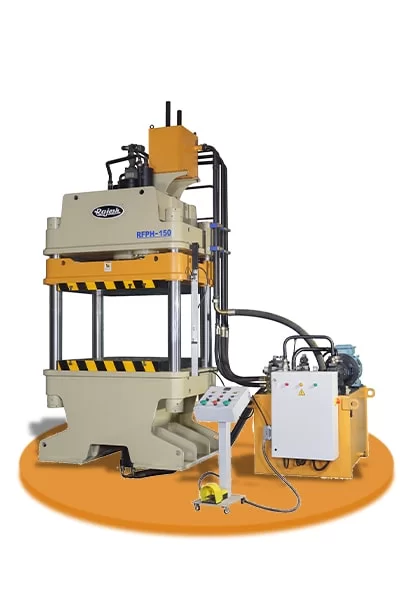
A hydraulic press machine with four columns uses pressure to apply significant force to a workpiece. Its defining feature is its four columns, which direct the platen’s movement and provide exact alignment and excellent stability.
The composition of the four pillar hydraulic press
The control mechanism and the host are the two components that compose the four pillar hydraulic press. Hydraulic cylinders, beams, columns, and liquid filling devices composed the bulk of the hydraulic press. Fuel tanks, high-pressure pumps, control systems, motors, pressure valves, directional valves, and similar components make up the power mechanism.
The Features of the Hydraulic Press
The device uses centralized button control with an independent power and electrical system to provide three operating modes for adjustments: manual, semi-automatic, and manual. The machine may accomplish the ejection process by adjusting its working pressure, pressing speed, no-load quick down, deceleration stroke, and range to the requirements of the process. Three ejection processes, including the stretching and ejection processes, are possible. Pressure is applied continuously throughout the process. There are two available process activities for continuous pressure. The ejection delay and automatic return following pressing are features of the constant pressure molding process.
The Application filled of the four pillar hydraulic press
Automotive Industry: Used to stamp and mold metal parts for cars and trucks, ensuring precision and durability of body panels and structural pieces.
Aerospace Industry: Used to make turbine blades and structural pieces for aircraft, where the press’s consistent, high-pressure forces are required.
Plastic Molding: Used in injection and compression molding to make complex, high-strength plastic parts for many applications
Metalworking: Required for forging, stamping, and bending sheet metal, allowing efficient manufacturing of many metal components used in various sectors.
Electrical Industry: Precision assembly of electronic components, assuring responsive factors are correctly positioned and strongly linked, is necessary for device performance and dependability.
Construction Industry: Boosts food production and packaging efficiency and consistency by pressing and packaging.
Advantages of Four-Pillar Hydraulic Press Machines
High Force Capacity: Hydraulic systems may generate immense force, making them suitable for heavy-duty applications.
Precision Control:Allows for exact control over characteristics such as pressure, speed, and stroke length, resulting in accurate output.
Versatility: Capable of executing a variety of operations on different materials, including forming, punching, bending, and pressing.
Safety Features: Protective guards and emergency stop buttons are included to make sure the operator is safe.
Reliability: Reliable four-pillar hydraulic presses produce precise and predictable outcomes over long periods of operation, assuring continued output and minimized downtime.
The working principle of the four pillar hydraulic press
This four pillar hydraulic press has a power mechanism, a control mechanism, an executive mechanism, an auxiliary mechanism, and a working medium that all work together to move the hydraulic system. An oil pump is often used as the power source. Usually, an integrated oil pump is used. It is possible to choose one or more oil pumps to meet the speed needs of the actuator.
A motor-driven pump sends hydraulic fluid to the hydraulic cylinder through a hose. The hydraulic cylinder then uses the fluid to move itself. Following that, the fluid needs to go through the valve and path on the way to the cylinder. This is the place where hydraulic energy is changed back into mechanical energy. Valves also control the flow of liquids and let off pressure when they need to.
It is capable of performing pressure processing and forming on a wide range of plastic materials. This includes extrusion, bending, stretching of stainless steel plates, and cold pressing of metal parts. It can also be used for pressing powder products, grinding wheels, bakelite, and resin thermosetting products.
Rajesh Machines is the best hydraulic press manufacturer in India. We make high-quality single-column and four-pillar hydraulic presses. Feel free to get in touch with us right away about your needs!