Introduction
Considering buying a hydraulic rolling machine? You probably have just one question: ‘Should I get a 3-roll or 4-roll machine?’ With every answer there comes different outcomes regarding how efficient your production line is, how fine your end product is, and how operational costs change over time.
Here at Rajesh Power Press India, we understand that it is not just machine specifications and capabilities. You also have to consider your exact manufacturing needs. Therefore, it is time to understand your needs. Let us explain everything you should know about these two popular types of rolling machines.
What is a Hydraulic Rolling Machine?
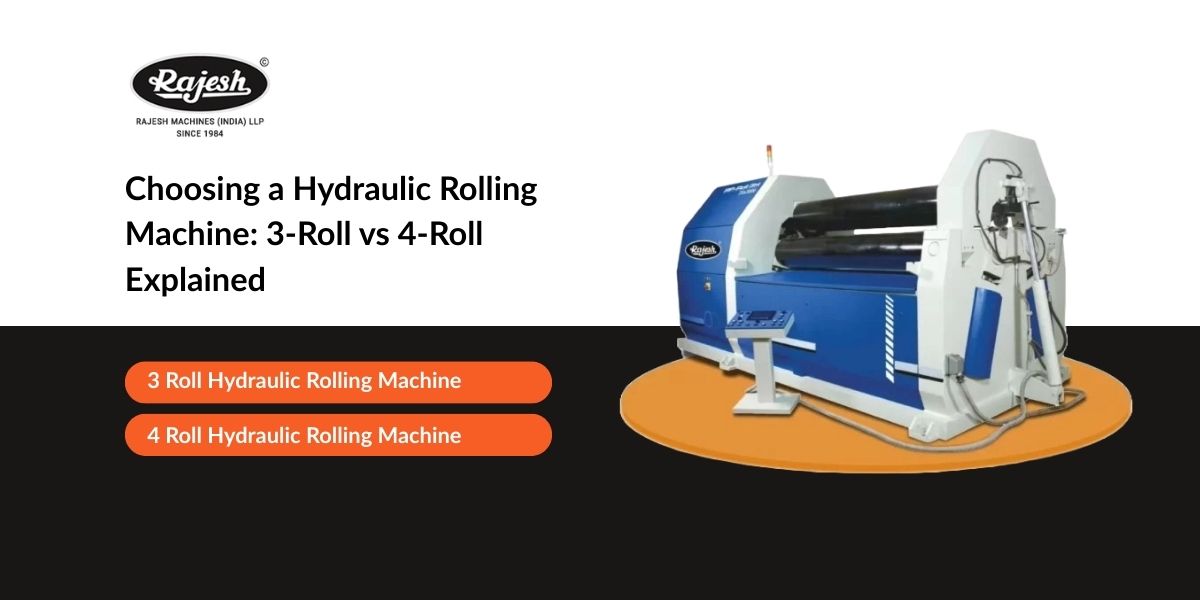
Hydraulic rolling machines efficiently create cylinders and other rounded forms from metal sheets. This goes on to help in the production of various items like pressure vessels, pipes and the architectural structures.
This rolling machine uses a set of rollers and hydraulic pressure. As the metal sheet is fed through the machine, it is bent consistently and progressively to achieve smooth and even curves without damaging the material.
3-Roll vs 4-Roll Hydraulic Rolling Machine: Which One Fits Your Business?
Let’s break down everything you need to know about these two popular types of rolling machines.
Understanding 3-Roll Hydraulic Rolling Machines
How 3-Roll Machines Work
A 3 roll hydraulic rolling machine features a straightforward design: two fixed bottom rollers and one adjustable top roller. The bottom rollers drive the rotation while the top roller adjusts vertically to control the bending radius.
This symmetrical configuration makes operation intuitive. The metal sheet is placed between the rollers and the position of the top roller is adjusted. The machine forms a desired curve of the sheet as the material is processed.
Key Features of 3-Roll Systems
- Compact Structure: The three-roller design requires minimal floor space so it can be used in workshops with limited area.
- Simple Operation: Operators can quickly learn the controls because of the simple mechanism. This translates to shorter training time and cost.
- Cost-Effective Solution: 3-roll machines which consist of simpler hydraulic systems require lesser capital and have lower maintenance costs.
- Versatile Thickness Range: These machines are capable of working with a wide range of material thicknesses, from 2mm to 200mm, which meets more varied manufacturing needs.
- Standard Shapes: The 3-roll machines are proficient in producing the standard shapes of O, U, and R-curves which are the most requested shapes in metal fabrication.
Ideal Applications for 3-Roll Machines
Three-roll machines are preferred by construction firms for structural steel bending. Small to medium-sized manufacturers find the well-balanced trade-off between capability and cost. Operational flexibility is beneficial for industries in varied product manufacturing in smaller batches.
The machine performs exceptionally well when you need reliable, consistent bending without extreme precision demands. Projects requiring standard cylindrical shapes or simple curves are perfect fits for 3-roll technology.
Exploring 4-Roll Hydraulic Rolling Machines
How 4-Roll Machines Operate
The more advanced 4 roll hydraulic rolling machine adds two side rollers to the configuration. This design allows operators to adjust the bending with extreme accuracy as each roller is controlled independently.
The additional rollers eliminate the need for pre-bending operations. Material flows through the machine in a single pass, with the side rollers supporting and guiding the sheet throughout the entire bending process.
Advanced Features of 4-Roll Systems
- Superior Precision: Due to its four-roller configuration, Superior Precision achieves tighter tolerances and greater control over the radius which is critical for high-specification products.
- Pre-Bending Capability: Side rollers automatically manage edge bending; thus, with 3-roll machines, the tedious pre-bending operation no longer has to be performed manually.
- Complex Geometry: These machines have the ability to perform multi-radius bending, work with conical shapes and continuous curves, all of which are arguably the most difficult functions to perform with standard rolling equipment.
- Enhanced Stability: Four-point contact provides superior material support eliminating material distortion while enhancing material surface finishing.
Best Applications for 4-Roll Machines
Automotive manufacturers rely on 4-roll machines for precision components. Shipbuilding facilities use them for hull plating where accuracy is non-negotiable. Aerospace and pressure vessel fabrication demand the precision that only 4-roll technology delivers.
The 4-roll system becomes exceptionally beneficial and justifiable for your investment in scenarios where your production runs are high-volume and consistently high quality needed, or when there are complex geometries and closely profiled tolerances, the 4-roll system justifies its investment through superior performance and reduced rework.
Head-to-Head Comparison: 3-Roll vs 4-Roll Machine
Structural Differences
The fundamental structural difference shapes every aspect of performance. Three rollers create a simpler mechanical system with fewer adjustment points. The presence of four rollers introduces added complexity yet affords considerably improved control over the bending operations.
This specific structural variation affects the level of maintenance needed, the operational versatility available, and the product range that can be produced.
Processing Capabilities
3-roll machines handle straightforward bending tasks efficiently. They create consistent cylinders and curves for standard applications. However, complex multi-radius work or conical shapes present challenges.
4-roll machines navigate these complexities effortlessly. Because independent roller control facilitates real-time, uninterrupted changes throughout processing, complex geometric configurations become possible that otherwise might not be feasible or would require a considerable investment of time on 3-roll systems.
Precision and Accuracy
3-roll equipment suffices for general fabrication where powerful tolerances are absent. In such cases, manual systems of simpler control down works accepted for general production work, obviating the need for more complex automated systems.
4-roll systems do excel when the need for precision with minimal tolerances and repeatability. In such cases, the hydraulic control systems provide fast, real-time adjustments, ensuring constant and uninterrupted control along all four bending axes.
Operational Efficiency
Operating a 3-roll machine requires pre-bending the sheet edges separately before final rolling. This two-step process adds time to each job but keeps the machine affordable and maintainable.
4-roll machines complete the entire process in one pass. Operators load the sheet, program the parameters, and retrieve the finished piece. This efficiency becomes crucial in high-volume production environments.
Price Considerations
Budget-conscious buyers appreciate that 3-roll machines cost significantly less than their 4-roll counterparts. The price difference reflects the simpler design and reduced component count.
However, a smart manufacturer looks beyond the price tag. With the reduced operating labor, the reduced scrap levels, and the incredible cutting power and speed of the 4-roll, these machines represent the better value for the extra money.
Selecting the Right Rolling Machine for Your Business
Assess Your Material Requirements
Start by analyzing what you actually manufacture. Document the material types, thickness ranges, and finished product dimensions you work with regularly. This data guides your capacity requirements.
Evaluate Production Volume
High-volume operations justify the premium for 4-roll automation and efficiency. Lower volumes might not generate sufficient return on the additional investment, making 3-roll machines more practical.
Consider Precision Demands
Review your quality specifications honestly. If customers accept standard tolerances and your products don’t require extreme precision, 3-roll machines meet the need. Tight tolerances and critical applications demand 4-roll accuracy.
Calculate Total Cost of Ownership
Look beyond the price tag. Factor in labor costs, training expenses, maintenance requirements, energy consumption, and potential rework from quality issues. The cheaper machine isn’t always the most economical choice over its lifetime.
Plan for Future Growth
Smart investors choose equipment that accommodates business expansion. If you believe that you will soon shift to more demanding work or need to increase production volumes further, then purchasing the more capable machine today is definitely cheaper than upgrading in a year or two.
Would you like to find out more about other types of rolling machines compared in the guide and how to choose the perfect fit for your production line? Be sure to check it out! Types of Rolling Machines – How to Choose the Right One for Your Industry.
Shop Hydraulic Rolling Machines from Rajesh Power Press India
Rajesh Power Press India stands as a trusted name among rolling machine manufacturers, delivering robust equipment designed for Indian manufacturing conditions. Our machines combine proven engineering principles with modern hydraulic technology.
Recognizing the importance of machinery investments, we offer both 3-roll and 4-roll configurations that guarantee dependable service for many years. Our technical team collaborates with customers to understand their production needs accurately so that we can provide the appropriate equipment—neither overselling nor undersizing.
Why Choose Rajesh Power Press India:
- Proven Reliability: Our machines operate in workshops across diverse industries, consistently performing under demanding conditions.
- Technical Support: Expert guidance helps you maximize equipment capability and troubleshoot any challenges quickly.
- Competitive Pricing: We deliver value without compromising quality, making advanced rolling technology accessible to Indian manufacturers.
- Comprehensive Training: Your team receives thorough operational and maintenance training, ensuring you extract maximum value from your investment.
Get the Right Rolling Machine for Your Industry
Find the perfect 3-roll or 4-roll hydraulic rolling machine that fits your production needs. Rajesh Power Press India combines trusted engineering with modern technology to deliver superior performance every time.
Making Your Final Decision
Ultimately, the decision between 3-roll and 4-roll hydraulic rolling machines comes down to aligning capabilities with your needs. 3-roll machines will suffice for standard fabrication when volume is not high and is a field-proven option available at a lower cost. 4-roll machinery should be used for high-precision parts, components with complex geometry, and long runs, as it pays for itself over time. From the strategic perspective, it is also imperative to take this as a company’s long-term investment: equipment purchases are part of a multi-year budget and will stay with you as the business grows.
Frequently Asked Questions
The main difference is in the configuration of the rollers: 3-roll machines have two bottom rollers and one top roller while 4-roll machines have two additional side rollers which allow for control and precision.
3-roll hydraulic rolling machines have a more competitive price and are therefore more suitable for small businesses which have more moderate production volumes and more standard bending requirements.
3-roll machines are generally designed for simple curves and standard cylindrical shapes. Complex bending in multiple radius or conical shapes is best accomplished with 4-roll machines.
4-roll hydraulic rolling machines provide greater precision owing to their extra support rollers and pre-bending ability, which makes them appropriate for tasks warranting tight tolerances and uniformity over numerous items.
For the straightforward production of cylindrical shapes, 3-roll machines tend to provide faster production speeds. Although 4-roll machines may take longer to complete each unit, they increase overall efficiency in complex tasks by removing pre-bending operations and lowering material wastage.